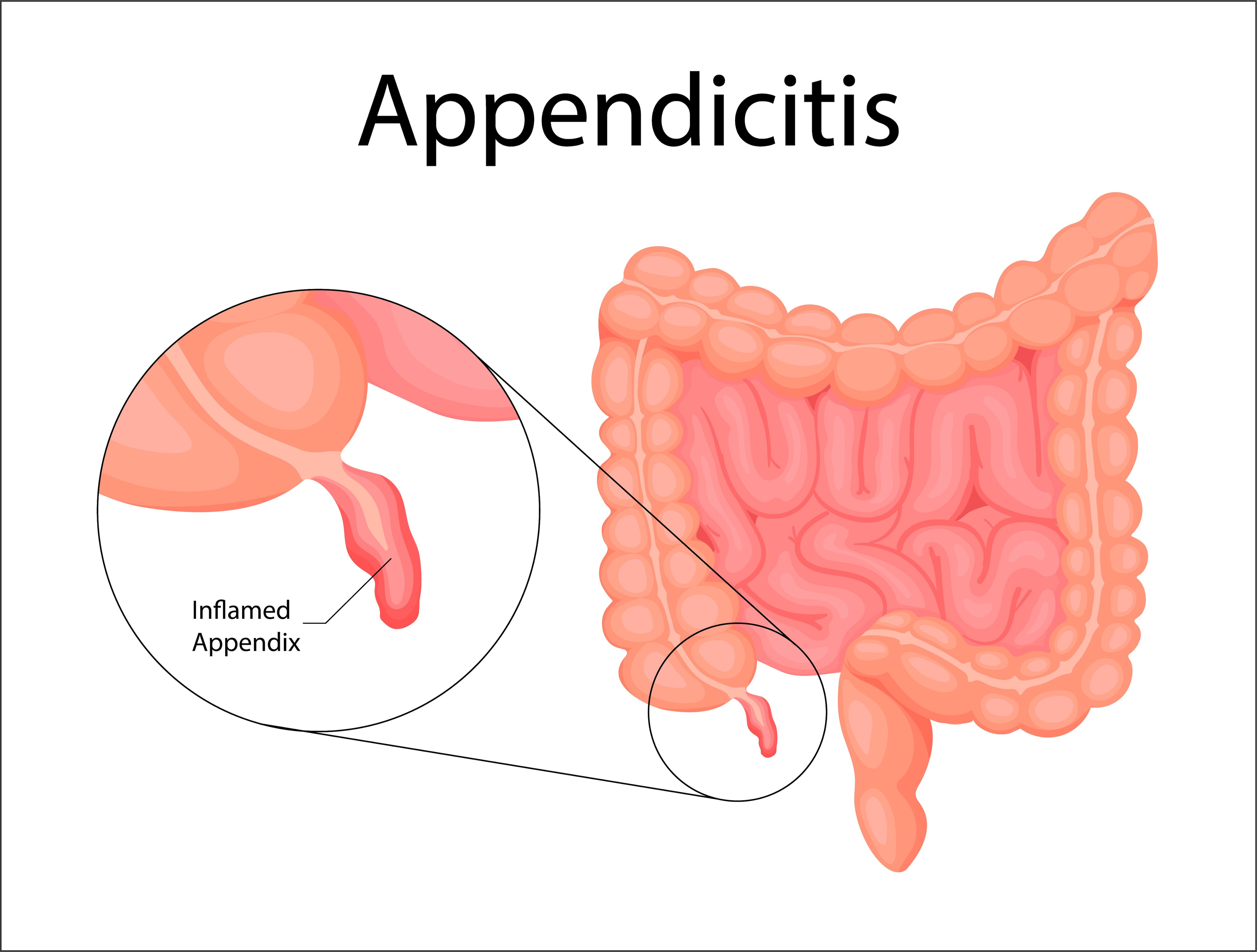
Appendicitis does not always begin as severe pain in the lower-right abdomen. Pain that starts near the navel, migrates, and continues to worsen deserves a different response from brief gas or indigestion, especially when vomiting, fever, tenderness, or faintness appears. By the end, you will know which symptoms require emergency assessment, how clinicians confirm the cause, and which findings make surgery more likely than observation or antibiotics.
Key takeaways
- Seek emergency care for worsening right-sided pain, fever, vomiting, or a rigid abdomen.
- Doctors combine examination, blood tests, urine tests, and imaging to confirm appendicitis.
- Appendectomy becomes more likely with rupture, an abscess, worsening pain, or failed antibiotics.
- Recovery and follow-up depend on whether the appendix ruptured and which operation was performed.
How appendicitis pain changes over time
Appendicitis pain often starts vaguely and then becomes more focused and persistent, so a changing pattern deserves urgent assessment rather than watchful waiting.
The appendicitis symptoms timeline commonly begins with pain near the navel or in the middle of the abdomen. Over several hours, the pain may move to the right-lower abdominal pain area and intensify as the appendix becomes inflamed. Walking, coughing, or pressing the abdomen can make it worse.
The key distinction is persistent abdominal pain versus gas or indigestion: gas often comes in waves and improves after passing stool or gas, while appendicitis pain usually remains, steadily worsens, or becomes painful with movement. Moderate pain still needs assessment if it continues or follows this migration pattern; severe pain is not required.
Seek urgent assessment when abdominal pain is:
- Progressively worsening or settling in the lower-right abdomen
- Accompanied by abdominal tenderness or pain when you cough or walk
- Continuing with fever, loss of appetite, nausea, or vomiting
- Associated with a rigid or swollen abdomen, faintness, confusion, or inability to keep fluids down
Do not wait for the pain to become unbearable. Urinary stones, bowel infection, Crohn’s disease, diverticulitis, and gynecological conditions can produce similar symptoms, so clinicians use examination and testing rather than pain location alone.
Which symptoms mean you should seek emergency care
Worsening abdominal pain with fever, repeated vomiting, or faintness warrants emergency care, not a routine appointment. Appendicitis can become dangerous after perforation, allowing infection to spread through the abdomen and bloodstream.
Seek immediate assessment if you have:
- Increasing pain, especially in the lower-right abdomen, or pain triggered by walking, coughing, or movement
- A rigid or very tender abdomen
- Fever with chills, confusion, severe weakness, or fainting
- Repeated vomiting or inability to keep fluids down
- Loss of appetite combined with persistent or worsening pain
Moderate pain still needs urgent assessment when it continues for hours or progressively worsens. Do not wait for severe right-lower-quadrant pain: appendicitis can begin around the navel or elsewhere, particularly during pregnancy, in children, or with unusual appendix anatomy.
| Symptom pattern | Action | Why it matters |
|---|---|---|
| Brief discomfort that fully settles, with no fever or vomiting | Arrange routine medical advice if it returns | Gas, indigestion, or another minor illness remains possible |
| Persistent pain, loss of appetite, nausea, or increasing tenderness | Seek same-day urgent assessment | Appendicitis and urinary, bowel, or gynaecological conditions can look similar |
| Worsening pain with fever, repeated vomiting, rigid abdomen, faintness, or confusion | Go to an emergency department now | Perforation, peritonitis, sepsis, obstruction, or severe dehydration needs rapid treatment |
How doctors confirm appendicitis and rule out look-alike conditions
Appendicitis diagnosis depends on the pattern of symptoms, abdominal examination, and test results together; persistent pain alone does not prove appendicitis or justify an appendectomy. A clinician checks tenderness, guarding, rigidity, pain with movement, bowel sounds, hydration, temperature, pulse, and blood pressure, then repeats the examination if the first findings are unclear.
Tests that help confirm appendicitis or identify another cause include:
- Blood tests: A raised white blood cell count supports infection or inflammation, while C-reactive protein indicates the degree and duration of inflammation. Neither result can confirm appendicitis by itself.
- Urine test: Blood can suggest a urinary stone, while white cells or bacteria point toward a urinary infection.
- Pregnancy test: In anyone who could be pregnant, this changes the assessment because ectopic pregnancy and pelvic conditions can mimic appendicitis, and it affects imaging choices.
- Ultrasound: It avoids radiation and is commonly used first for children and during pregnancy, but bowel gas or the appendix’s position can make the result inconclusive.
- CT scan: CT gives detailed images for many adults with uncertain pain and can show an inflamed appendix, perforation, abscess, bowel obstruction, diverticulitis, or Crohn’s disease.
- MRI: MRI provides an alternative when pregnancy makes radiation undesirable and ultrasound does not answer the question.
An unclear scan does not automatically lead to surgery. Doctors may observe you, repeat the abdominal examination, and repeat imaging while considering gastroenteritis, ovarian disease, urinary stones, or other look-alike conditions. Clear imaging plus worsening clinical findings calls for prompt surgical assessment.
Which findings make appendectomy more likely than antibiotics or observation
An inflamed or enlarged appendix on ultrasound or CT does not by itself decide treatment. Doctors look for an appendicolith, a wall defect, extraluminal air, fluid, an abscess, or widespread inflammation, then combine those findings with tenderness, guarding, rigidity, fever, and the patient’s overall condition.
| Finding | What it suggests | Usual treatment direction |
|---|---|---|
| Uncomplicated appendicitis | Inflamed appendix without perforation, abscess, or diffuse peritonitis | Laparoscopic appendectomy is definitive; selected adults may choose antibiotics, with recurrence risk. Observation requires serial examinations. |
| Appendicolith with persistent symptoms | A stone blocking the appendix and a higher chance of treatment failure or recurrence | Appendectomy becomes more attractive than antibiotics alone. |
| Perforated appendicitis with a contained abscess or phlegmon | Infection is walled off rather than spreading freely | Antibiotics, close reassessment, and sometimes image-guided drainage; delayed surgery is considered if needed. |
| Free perforation, diffuse peritonitis, or sepsis | Infection is escaping throughout the abdomen or causing systemic illness | Urgent operation for source control, usually appendectomy and abdominal washout. |
A normal-looking appendix with improving pain and no concerning examination findings supports observation, not automatic surgery. Persistent localized tenderness, worsening pain, repeated vomiting, fever, rising illness severity, or failure to improve shifts the balance toward appendectomy or drainage. Antibiotics do not guarantee permanent cure, even when imaging confirms uncomplicated disease.
What surgery and follow-up decisions depend on the severity
Laparoscopic appendectomy is preferred when the patient is stable and the surgeon can safely reach the appendix. It uses smaller incisions and usually means less pain, a shorter hospital stay, and faster recovery.
An open appendectomy can be safer when the infection has spread, the abdomen is difficult to access, laparoscopy is unavailable, or the surgeon must convert during the operation. Appendicitis during pregnancy requires prompt treatment; ultrasound or MRI often guides diagnosis, while the surgical approach depends on gestational stage, anatomy, and clinical judgment.
Staged treatment may suit an appendiceal abscess or inflammatory mass that can be controlled with antibiotics and image-guided drainage. Do not assume that successful nonoperative treatment requires an interval appendectomy: recurrent symptoms or other concerns can change the decision.
If you are 40 or older, ask about follow-up imaging or colon evaluation because an abscess can conceal an appendiceal or colonic tumour.
After surgery, seek urgent reassessment for worsening pain, persistent fever, repeated vomiting, abdominal distension, faintness, or wound redness or drainage. These postoperative warning signs can indicate an abscess, infection, bowel paralysis, or another complication.
Whether you consult BariFit By Dr Parmeshwar or another surgical team, ask:
- Why is laparoscopy, open surgery, drainage, or antibiotics safest for me?
- Is an appendicolith, perforation, abscess, or diffuse infection present?
- What activity limits and follow-up tests apply?
- Which symptoms require immediate return?
Related service
Appendectomy Appendectomy Appendectomy is a surgical procedure performed to remove the appendix, a small pouch attached to the large intestine. |
Frequently asked questions
How does appendicitis pain change over time?
Pain often begins near the navel, then moves to the lower right abdomen and becomes more focused and persistent. Movement, coughing, or pressing the area can worsen it.
Which appendicitis symptoms require emergency care?
Seek emergency care for worsening abdominal pain, fever, repeated vomiting, a swollen or rigid abdomen, confusion, fainting, or pain that briefly improves before becoming severe.
How do doctors confirm appendicitis and rule out similar conditions?
Doctors use your symptom history and abdominal examination alongside a complete blood count, C-reactive protein, urine testing, pregnancy testing when relevant, and ultrasound or CT imaging.
When is appendectomy more likely than antibiotics or observation?
Surgery is more likely when imaging shows perforation, an abscess, widespread infection, an obstructed appendix, worsening symptoms, or recurrence risk that makes nonoperative treatment unsuitable.